

Western Market Strategy for the United States and Europe
with the Cavmir team
Why this report exists.
To the leadership team at Gathern,
A few weeks ago we spoke about the West. You decided not to hire us, and that is a perfectly good decision. I still wanted to give you something.
This report is that something. It is the document we would have written in the first forty-five days of an engagement, and it comes with an invoice for USD 2,500 that I have paid myself. Nothing is owed. There is no proposal at the back and no phone number to call. I wanted you to have the work, and I wanted it to be worth exactly what the invoice says.
Why bother? Because what you are about to attempt is hard, and because we spend our days on the exact piece of it you have not done yet: getting Americans and Europeans to trust, choose and return to a place they have never been. Cavmir markets vacation rentals and boutique hospitality in the United States and abroad, and that is the lens of every page here. We do not pretend to know the Saudi market better than you do. Nobody does.
Some of what follows will be uncomfortable. I have written it plainly because a polite report is a useless report. The bilingual identity, the App Store title, the Arabic greeting on your English homepage, the refund complaints sitting on your US storefront: these are the first things a Western guest meets, and every one of them is fixable. I would rather you hear it from someone who admires what you built than discover it in a funnel that never converts.
One idea runs through everything. Kevin Roberts, when he ran Saatchi & Saatchi, argued that the brands people stay loyal to beyond reason earn both respect and love. He called them Lovemarks. Cavmir was built on that idea. Gathern already has the love at home. In the West it has neither yet, and the order matters: respect first, then love. The whole plan is organized around earning them in that order.
Please read it as it was written, with respect for what you have built and with real excitement about what the Kingdom is opening up. If any of it helps, it has done its job.
Miami, September 2026
What is in this report.
Gathern is built for the Kingdom's growth and not yet built for a Western guest.
Everything a Westerner meets first is unfinished: a bilingual store title, an Arabic greeting on the English homepage, categories no foreigner can read, no guest currency, refund complaints atop the US storefront. None of it is structural. All of it is fixable within two quarters.
The Kingdom is adding hundreds of thousands of hotel rooms, Expo 2030 and the 2034 World Cup are on the calendar, and the Red Sea and AlUla are in every travel magazine that matters. The Western guest is coming whether Gathern is ready or not. This report answers how Gathern becomes the place that guest books, returns to and recommends, and what that should cost.
The answer has four parts. Brand: one English-only Western door and a Lovemark earned in the right order, respect first. Guests: four distinct people, four messages, four products. Money: three budget gates from a USD 300,000 proof to a USD 3.5 million scale-up, measured the way an American growth team measures. Product: a Western app and Western pages separated from the home product.
The twelve recommendations.
| # | Recommendation | Why it matters | When | See |
|---|---|---|---|---|
| 1 | Open one English-only Western door. A .com domain, an English store listing, no Arabic script on any touchpoint the guest meets first. | Unknown script on an unknown brand reads as "not for me" in under a second. | Q4 2026 | §3 |
| 2 | Earn respect before love. A guest guarantee, a plain refund policy, 24/7 English human support with a phone number. | The US storefront complaints are about exactly this. | Q4 2026 | §3, §9 |
| 3 | Rent demand before you own it. A curated International Collection on Airbnb, Booking.com and Vrbo as the first-stay channel. | The first booking happens where trust already exists. The app earns the second. | Q1 2027 | §5 |
| 4 | Market to four guests, not one. First-timer, repeat visitor, digital nomad, luxury traveller: four messages, four products. | One message for everyone converts no one. | Q1 2027 | §4 |
| 5 | Sell destinations, not property categories. The Western site opens with AlUla, Riyadh, Jeddah, the Red Sea, Abha, Taif and Diriyah. | Nobody in Ohio searches for an "istraha". Everyone searches "where to stay in AlUla". | Q1 2027 | §6 |
| 6 | Price in the guest's currency, take the guest's wallet. USD and EUR, Apple Pay, Google Pay, PayPal, Klarna for Europe. | Riyals only is a checkout abandon in the US. | Q1 2027 | §6, §9 |
| 7 | Make the founders' story the brand's mystery. An American-educated woman built the Kingdom's first licensed home-sharing platform. | It rewrites the reader's assumptions, and journalists want to write it. | Q1 2027 | §3, §9 |
| 8 | Turn the Saudi welcome into a product feature. Coffee, dates and a host greeting on every international arrival. | This is the Lovemark's intimacy, and the most shared moment of the trip. | Q2 2027 | §3, §10 |
| 9 | Create an International-Ready host tier. English-fluent badge, response SLA, Western-standard photos, instant book. | The guest is buying the host. The badge makes 72,000 units usable. | Q1 2027 | §6, §9 |
| 10 | Stage the budget through three gates. Prove (USD 300k), Build (USD 1.2M), Scale (USD 3.5M). | Scale money before Prove numbers is how launches die quietly. | 2026 to 2028 | §7 |
| 11 | Measure like an American growth team. Blended CAC, marketing-efficiency ratio, payback in stays, weekly scorecard, geo holdouts. | Every platform dashboard will claim the same booking. | Q4 2026 | §8 |
| 12 | Fix the small things this month. Typos, the 50,000 versus 72,000 count, the store title, the ID-type order. | Small errors decide whether the big promises are believed. | Now | §11 |
The one thing
If only one recommendation survives, make it the first. Without an English-only Western door with respect built in, budget spent on the West buys traffic that arrives, hesitates and leaves.
The hard part is done.
Three of those facts matter more than the rest for the West. The licence is a trust asset no competitor can copy, and it is invisible to a foreigner today because nothing on the English surface explains what it means. The inbound mandate is now a promise to investors, which means the international revenue line will be read by analysts preparing the 2028 listing; a credible Western story is worth more than its bookings. And the founding story is, without exaggeration, the best marketing asset the company owns for an American or European audience. Section 3 returns to it.
Gathern does not have a supply problem, a licence problem or a capital problem in the West. It has a translation problem, in the widest sense of the word: the product, the brand and the promise have not yet been translated into the way a Western guest decides.
The Western guest is not yet in the numbers.
Where inbound growth came from in 2025
The strongest gains were Egypt, Pakistan, Kuwait, India and Indonesia, driven by Umrah travel and new air routes. Not one of the top growth markets is in North America or Western Europe. Leisure is a quarter of inbound; the rest is religious travel and family visits, which Gathern already serves well and which do not need a Western strategy.
What the target implies
Vision 2030 now aims for 150 million visits a year, 70 million of them international, with 320,000 hotel rooms being built to house them. The Saudi Tourism Authority runs offices and campaigns in Western source markets. In plain terms, the government is paying for the awareness. Gathern's job is to be where a newly curious American lands when they ask "where would I actually stay?"
The barriers that used to exist are gone
- Visa. Citizens of 66 countries, including the US, the UK and the EU, get a one-year multiple-entry e-visa online for about SAR 480 to 535 (USD 128 to 143), up to 90 days per visit. Holders of a used US, UK or Schengen visa get a visa on arrival.
- Access. Riyadh Air, Saudia and flynas expansion, and the Red Sea International Airport put the Kingdom one stop from every US and European hub.
- Product. AlUla, Diriyah, the Red Sea resorts and Riyadh Season give a Western editor something to write about that did not exist five years ago.
The barrier that remains
Perception. In Gallup's February 2026 country ratings, 36% of Americans held a favorable view of Saudi Arabia, against 59% for Egypt, 66% for Mexico and 85% for Japan. A Western guest arrives curious and wary in equal measure. Every page of this report is written for that person.
The strategic read
Gathern does not need to convince Americans to visit Saudi Arabia. The state, the resorts and the events are doing that at a scale no company could match. Gathern needs to be trusted by the ones who have already decided to come. That is a narrower, cheaper and far more winnable job.
Eight years of reasons to come.
Riyadh Season, Formula 1 in Jeddah, the Esports World Cup, the Saudi Cup, Winter at Tantora in AlUla
Recurring reasons to visit with fixed dates. Each one has an audience in the US and Europe that already books international travel around it.
The Red Sea opens at scale
Red Sea Global brings its resort count to 16 with 3,000 rooms and about 300,000 expected guests, including Four Seasons at Shura Island and Raffles late in the year. This is the year the luxury press decides what Saudi luxury looks like.
AFC Asian Cup
Football across the Kingdom's cities. A rehearsal, in operational and marketing terms, for 2034.
Asian Winter Games at Trojena
An event whose novelty alone guarantees Western coverage.
Expo 2030 Riyadh
Six months, more than 40 million expected visits. Expos historically draw a large, older, well-funded Western audience and exhaust hotel supply. Private stays fill the gap.
FIFA World Cup and the Asian Games
The single largest inbound event the Kingdom will ever host, with more than 230,000 hotel rooms needed. Every World Cup has been a home-sharing boom in the host country. This one is eight years away, which is exactly how long it takes to build a Western brand that people trust.
Gathern's own date
The planned Tadawul listing. The international revenue line, and the story behind it, will be part of the prospectus.
Do not build the Western plan for 2034. Build it for the next date on this calendar, prove it, and let each event fund the next. The 2034 guest will book with whoever was trustworthy in 2027.
How the American guest thinks.
Trust comes before desire.
An American decides whether a brand is safe before deciding whether they want it. Beautiful photos on an untrusted surface produce admiration and no booking.
Reviews are the product.
71% of US consumers read online reviews regularly; 4% never do (BrightLocal). The review is read before the description. No English reviews means no reviews.
The card is a shield.
Americans pay by credit card because the card company sides with them in a dispute. A checkout that seems to remove that protection feels like risk.
Refunds are assumed.
Free cancellation is the default expectation. A strict policy is acceptable if stated plainly up front. An unclear policy is not acceptable at any price.
Someone must answer the phone.
Chat is fine until the door will not open at 3 a.m. Then an American expects a human, in English, on the phone. This is the complaint on your US storefront today.
Familiar means safe.
Americans book unfamiliar places through familiar brands: Airbnb, Vrbo, Expedia, Google. Section 5 tells you to rent that trust before you own it.
Plain speech wins.
American copy sounds like a friend talking: short sentences, second person, prices with no asterisks. Ceremonial language reads as foreign or evasive.
The three-second mobile test.
The guest arrives on a phone, from a link, and decides in three seconds: Is this real? Is it for me? What does it cost? One unanswered and they are gone.
They want to be a good guest.
The American who chooses Saudi Arabia is curious and slightly anxious about dress, alcohol, photography, greetings. Answer plainly and anxiety becomes loyalty.
They tell everyone.
Get the above right and Americans post. A first trip to Saudi Arabia is a story, and the platform that made it easy becomes part of it.
How the European guest thinks.
Booking.com is home.
Booking.com holds about 48% of Europe's short-term rental bookings. A German or Dutch guest opens it first, compares, and expects free cancellation as normal.
The price is the price.
European law and habit require the displayed price to be the total price, taxes and fees included. A price that grows at checkout is a reason to leave and to complain publicly.
Privacy is a right, not a setting.
GDPR is enforced and Europeans notice. A truthful consent banner, a plain privacy policy and no tracking before consent are part of looking legitimate.
They have already been to the region.
Dubai, Egypt, Jordan, Morocco and Oman are short-haul for Europeans. They compare Saudi Arabia to Oman and Jordan, not to the unknown.
Longer trips, earlier planning.
Two-week holidays and 25 to 30 days of leave mean longer stays, earlier booking windows and a natural fit for the monthly-stay product Gathern already runs.
Winter sun is the motive.
Northern Europeans buy warmth from November to March. The Red Sea, Jeddah and AlUla in January compete with the Canaries, Egypt and Dubai, and can be sold that way.
Language must be native.
English works for the Dutch and Scandinavians. Germany, France, Italy and Spain convert far better in their own language and notice machine translation. Launch in English; localise two markets in year two.
Klarna, PayPal, iDEAL, SEPA.
Cards are less universal than in the US. PayPal is trusted everywhere, Klarna in Germany and the Nordics, iDEAL in the Netherlands. Offer the local method or lose the local guest.
Authenticity is asked about.
Europeans ask what a stay does for the place and the people. "Hosted by a local family" is a stronger claim in Europe than "luxury", and Gathern can make it truthfully.
Less patriotic, more sceptical.
Government-backed marketing lands with more suspicion in Europe. A private, founder-led, licensed company with real hosts is the better messenger. That is Gathern.
American and European guests side by side.
| Decision | The American guest | The European guest | What Gathern should do |
|---|---|---|---|
| First door | Google, Airbnb, Vrbo, Expedia, Apple App Store | Booking.com, Google, Airbnb, national OTAs | Be listed where the guest already is; own the second stay in the app |
| Currency | USD only. Riyals are meaningless | EUR, GBP, CHF, SEK; converts riyals mentally to euros | Display in guest currency, charge in guest currency where possible |
| Price display | Tolerates fees at checkout, resents them | Total price by law and habit; fees at checkout are a dealbreaker | Show the all-in nightly price everywhere on the Western surface |
| Payment | Credit card, Apple Pay, PayPal | Cards, PayPal, Klarna, iDEAL, SEPA, pay at property | Card plus Apple Pay and PayPal at launch; Klarna and iDEAL in the EU phase |
| Cancellation | Expects free cancellation, will accept clear strict terms | Expects free cancellation; Booking.com trained this | A single, plain policy per listing, shown before the price |
| Trip length and window | 5 to 9 nights, booked 4 to 10 weeks out, often paired with Dubai or Jordan | 7 to 21 nights, booked 2 to 6 months out; monthly stays in winter | Itinerary bundles and instant book for the US; monthly product and longer retargeting for Europe |
| Reviews | Reads star count, then the worst review | Reads the score out of 10 and the host's replies | Reply to every review in English; surface host reply rate |
| Support | Phone and chat, 24/7, English, immediate | Email and chat acceptable; wants a written record | 24/7 English chat plus a US and UK phone number |
| Main worry | "Is it safe, and is it for me?" | "Is it worth it, and is it authentic?" | Safety and belonging content for the US; value and authenticity for Europe |
| Privacy and legal | CCPA; ADA accessibility suits; TCPA text consent | GDPR, enforced and noticed | Consent before tracking, WCAG accessibility and SMS consent from day one |
The rule of thumb
Build the Western product for the American first: the harder guest to reassure, the easier guest to reach. What satisfies an American satisfies a European once price display, payment methods and privacy behaviour are set correctly.
What a Western guest meets in the first minute.
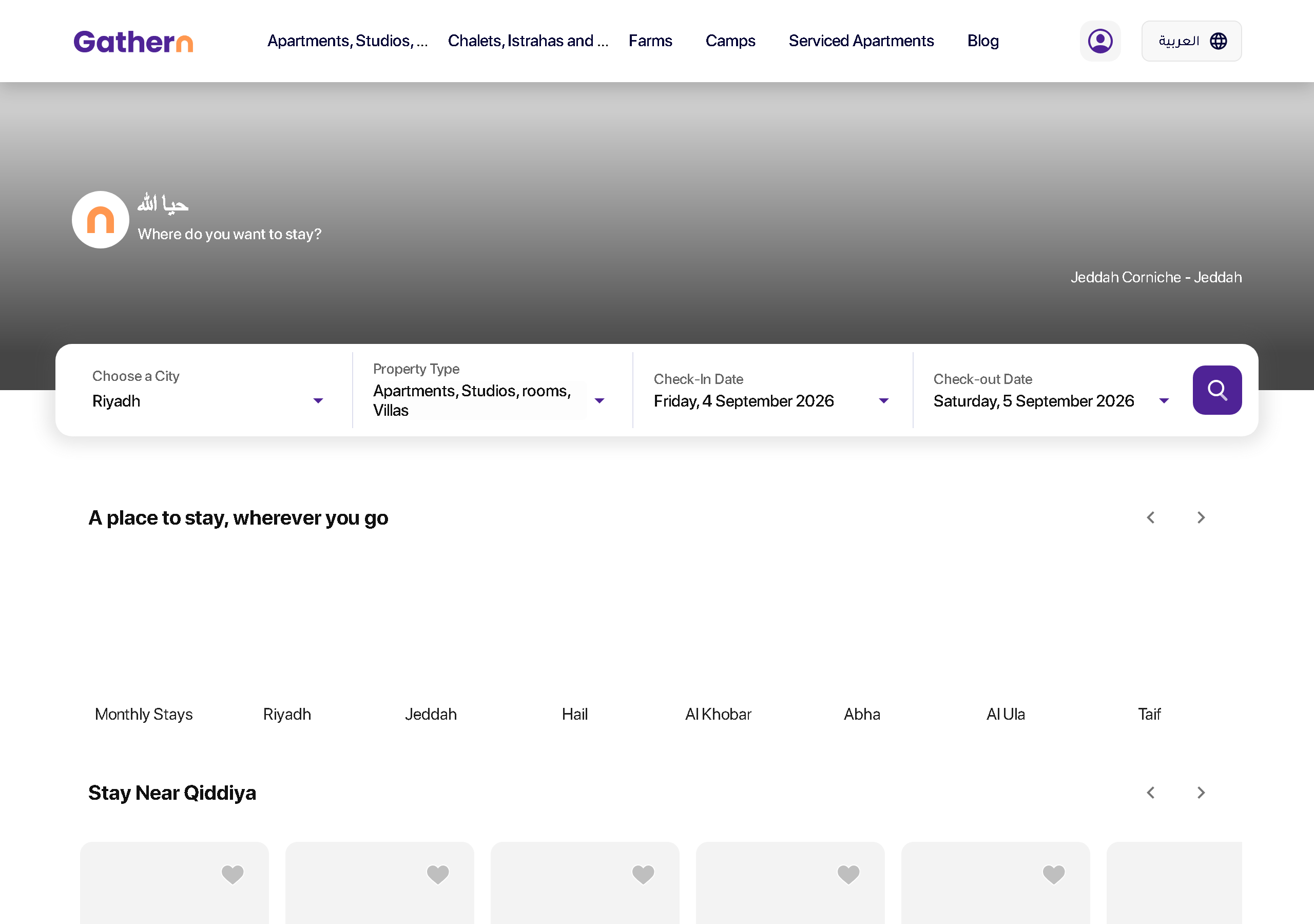
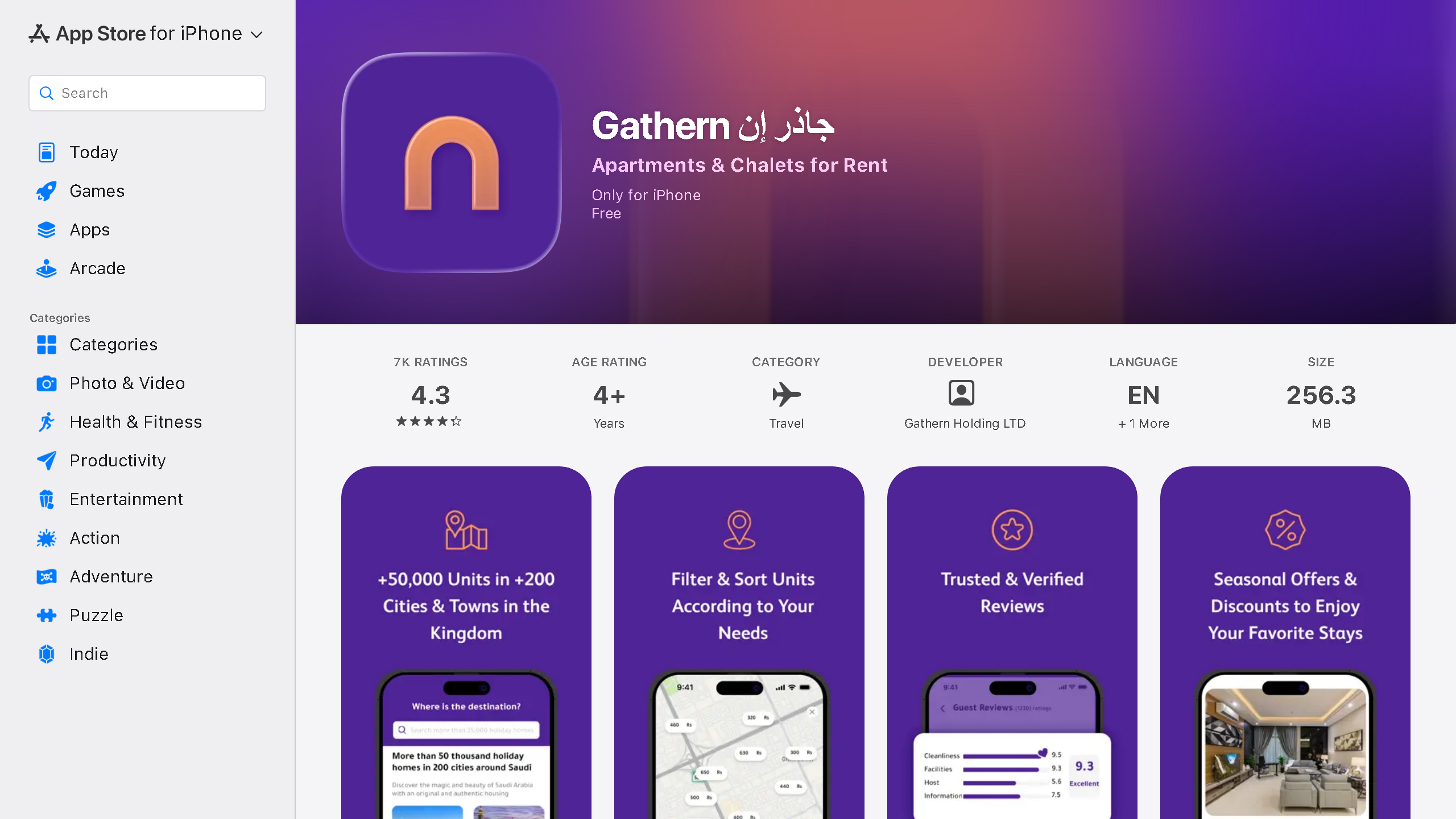
Arabic script on English-language touchpoints.
The store title, the share card name ("Gathern | جاذر إن"), the home-screen app title ("جاذر إن"), the homepage greeting and the sponsor line all present Arabic script to a reader who cannot read it. The page also declares its locale as ar_SA to Facebook and Google.
Category names that only a Gulf resident understands.
"Istrahas" is untranslated. "Chalets" means a beach or pool day-house in the Gulf and a ski cabin to a European. "Farms" means a private garden estate here and agriculture in Iowa. The Western guest cannot map any of these to what they want.
Guest verification puts the tourist last and misspells the button.
ID type offers "Saudi National", "Resident (Saudi)" and "Vistor/tourist", in that order, with a "VERFIY" button. A foreigner reads: this was built for someone else, and nobody checked it.
Numbers that disagree, prices that cannot be read, support that cannot be reached.
50,000 units in the store, 72,000 on the site, "more than 180 cities" in the search bar and "more than 200" in the app. Prices are in riyals only. The visible US reviews describe chat-only support, refused refunds and a guest locked out for eight hours. The App Store privacy label says the app may track the user across other companies' apps.
Drop the Arabic script from every Western touchpoint.
Keep the bilingual identity at home, where it is right and earned. In the United States and Europe, present one English-only identity: an English store title, an English share card, an English greeting, English category names and a .com domain. Not one glyph of Arabic script on any surface a Western guest meets before they have booked.
Why
An American who sees a script they cannot read on a brand they have never heard of does not think "how authentic." They think "this is not for me," and the thought takes under a second. It is not prejudice so much as pattern recognition: unreadable text on an unknown app is what a scam looks like to them. On a brand they already trust the same script becomes charm. Trust has to come first, and Gathern does not have it yet in the West.
The obvious objection
Emirates, Qatar Airways and Etihad carry Arabic calligraphy in their marks and Americans fly them happily. True, and each of them spent two or three decades and billions of dollars in Western sponsorship (Arsenal, Real Madrid, Formula 1, the US Open) to make that script familiar. Gathern has neither the time nor the budget for that road, and it does not need it. The airlines earned the right to be exotic. Gathern must first earn the right to be trusted.
The precedent
ByteDance launched Douyin in China in September 2016 and, one year later, launched TikTok as a separate app for everyone else. Same company, same engine, different name, different store listing, different content and rules. Toyota created Lexus for the American luxury buyer. Sony chose a name in the 1950s that any Westerner could pronounce. None of these companies became less Japanese or less Chinese. They built a door their customer could walk through.
What this is not
It is not "Disneyfication," the sanding-down of a culture into a theme park. The stays, the hosts, the coffee, the desert, the call to prayer at dusk stay exactly as they are; they are the product. What changes is the interface: the words, the currency, the payment, the support, the name in the store. Translate the interface, keep the soul. Section 3 shows how the soul becomes the brand.
What stays
The English wordmark and the orange gate are good. The gate reads as a welcome to anyone, and "Gathern" is easy for an American mouth. The lavender works. The store title becomes "Gathern: Stays in Saudi Arabia." The essence "Hospitality, from us and for us" is inward-facing and should be rewritten for the guest, which page 17 does.
Build a Lovemark, in the right order.
Roberts' argument is that people are about 80% emotion and 20% reason, and that the brands they stay loyal to beyond reason sit high on two axes at once: respect (performance, trust, reputation) and love (mystery, sensuality, intimacy).
At home, Gathern is close to a Lovemark. Five million users, the licence, the founders' story and "Hospitality, from us and for us" put it high on both axes. In the West it starts at the bottom left: unknown, unread, with its first impressions working against it.
The order is the strategy. Respect is earned first, through performance: the refund that arrives, the phone that is answered, the price that does not change, the door that opens. Only then does love become possible. Brands that try to be loved before they are respected become fads, or worse, become the brand a guest warns friends about.
The next three pages take the two axes in order: what earns respect from a Western guest, then what earns love, then the story that ties them together.
Earning respect first.
The Gathern Guest Guarantee.
One page, one paragraph per promise: if the stay is not as listed, we rehouse or refund you within 24 hours. Airbnb calls its version AirCover. The Western guest looks for it by reflex and reads its absence as a warning.
One cancellation policy per listing, before the price.
The US review complaining of "some units partial deposit, others full deposit, even if refundable" describes the problem exactly. Three named policies (Flexible, Moderate, Strict), one per listing, on the card.
A human on the phone, in English, all night.
A US toll-free number and a UK number, answered 24/7 by people who can act. Chat-only support with no escalation is the most repeated complaint on the US storefront. Budget it under marketing, because that is what it is.
The price that does not change.
All-in nightly price in the guest's currency on the card, on the listing and at checkout, the same number in all three places.
Verification that treats the tourist as the main event.
Passport verification first on the Western surface, with one sentence on why it is asked and what the licence means: every host operates under the Ministry of Tourism's licence, which is why you are protected.
A reply to every review, in English, within 48 hours.
Especially the bad ones. A calm, specific reply to a one-star review converts more Western readers than ten five-star reviews, because it shows what happens when things go wrong.
| Signal | Today (US storefront) | Target, two quarters after launch |
|---|---|---|
| App Store rating, US | 4.3 from about 7,000 ratings | 4.6 or better on the Western listing |
| Share of English reviews mentioning refunds or support negatively | Majority of the visible first page | Under 10% |
| First-response time, English support | Not published | Under 2 minutes chat, under 60 seconds phone, published |
| Rehousing or refund resolution | Not published | Within 24 hours, published, audited monthly |
Earning love.
Stories
What it is. Great stories, past, present and future, myths and icons, inspiration. The reason to lean in.
What Gathern has. Two women who read a hundred business books in Ohio and came home to build the Kingdom's first licensed home-sharing platform. Hegra, older than Petra and almost empty. The fog of Abha, the roses of Taif, a night in a desert camp. The site already says "Stay Amid the Fog" and "Stay Near the Roses." Those are the right instincts, written for the wrong audience.
The senses
What it is. Sight, sound, scent, touch, taste. Roberts called the senses the portals to emotion.
What Gathern has. Cardamom coffee poured from a dallah. Dates on arrival. Oud and bakhoor in the hallway. The call to prayer over a Jeddah rooftop at sunset. The silence of the Nafud at night. Western guests photograph and post these things because nothing at home resembles them. The brand should own them on purpose.
The host
What it is. Commitment, empathy, passion. The feeling that the brand knows you.
What Gathern has. 33,000 hosts and a culture in which welcoming a stranger is a matter of honour. This is the one thing Airbnb cannot import into Saudi Arabia and Booking.com cannot list. It is also the thing a nervous first-time American most needs: a person who is glad they came.
Make the welcome a guaranteed product feature on every international booking: coffee, dates and a greeting card from the host, photographed for the listing, mentioned in the confirmation, asked about in the review. Call it what it is in English: "The Welcome." It costs a host a few riyals. It is the most shareable thirty seconds of the trip, and it is the intimacy Roberts was describing.
Two cautions. Love in the Western market must never be claimed; it has to be reported by guests, which is why the review reply and the welcome photograph matter more than any advertisement. And the raw material above must be used with restraint. One camel, one falcon or one "mystical Orient" headline and the Western reader files the brand under cliché.
The founders' story and the promise.
The story, as a Western editor would tell it
In 2016 a Saudi student in Ohio watched her neighbour sublet on Airbnb and realised her country had nothing like it. She read a hundred books, made "the longest call of my life" to a friend back home, and in 2017 the two of them launched Gathern in Riyadh. Their first customer was a co-founder's mother. Six years later the company was the first home-sharing platform licensed by the Ministry of Tourism, held 44% of its market, and in 2025 became the highest-valued venture-backed company in the Middle East founded and led by a woman.
Everything in that paragraph is on the record (Endeavor, Wamda). It also does three jobs at once for a Western reader: it makes the brand human, it answers an unspoken question about who runs Saudi companies, and it explains why the platform is safe (the licence) without a legal paragraph.
How to use it
- A founders' page on the Western site, with photographs, in the first person.
- The lead of every US and European press pitch (Section 9).
- Two sentences in the app's onboarding, before the first search.
- Latifah Altamimi on two or three US travel and business podcasts a quarter.
Rewriting the essence for the guest
"Hospitality, from us and for us" is a fine internal creed, and in the West it reads as a closed circle: from us, for us, not you. The Western promise must face outward.
Two alternative directions, for testing against the first:
- "A home in the Kingdom, and a host who is glad you came."
- "Licensed, hosted, welcomed. Stays in Saudi Arabia."
What the identity keeps and changes
| Element | Home | Western door |
|---|---|---|
| Wordmark | Gathern, the gate as n | Same |
| Store title | Gathern جاذر إن | Gathern: Stays in Saudi Arabia |
| Greeting | حيا الله | "Welcome. You are our guest." |
| Essence | Hospitality, from us and for us | Faces the guest (above) |
| Colour | Lavender, orange gate | Same, plus photography-led layouts |
| Domain | gathern.co | gathern.com or a .com the company can own |
Four Western guests, four different sales.
The first-timer
Who. An American or European who has never been to the Middle East, drawn by AlUla, an event or curiosity.
Wants. To be told it is safe, real and for them. Everything explained once, plainly.
Fears. Doing something wrong. Being scammed. Being alone with a problem.
The repeat visitor
Who. Has been to the Gulf or to the Kingdom for work, Umrah, family or an event. Comes back for more.
Wants. A better stay than last time, faster. Neighbourhood knowledge. Recognition.
Fears. Wasting a trip on the wrong district; paying tourist prices.
The digital nomad
Who. Remote worker, 28 to 45, four to twelve weeks in one place, winter-chasing, community-seeking.
Wants. Fast wifi, a desk, a monthly price, a coffee shop and other nomads.
Fears. Isolation, visa confusion, a listing that lied about the internet.
The luxury traveller
Who. High-net-worth American or European, often booking through an advisor, chasing the Red Sea, AlUla and privacy.
Wants. A private estate with staff, discretion, a concierge who says yes.
Fears. Anything that feels amateur. Surprises. Being photographed.
| First-timer | Repeat visitor | Digital nomad | Luxury | |
|---|---|---|---|---|
| Typical stay | 5 to 9 nights, two cities | 3 to 14 nights, one city | 28 to 90 nights | 4 to 10 nights, one estate |
| Spend per night | USD 90 to 220 | USD 80 to 250 | USD 40 to 90 (monthly rate) | USD 600 to 3,000+ |
| First door | Google, Airbnb, press, creators | Email, the app, Booking.com | Nomad communities, YouTube, Reddit | Travel advisors, luxury press |
| Decides on | Safety, clarity, reviews | Location, value, speed | Wifi, price, community | Privacy, staff, taste |
| Priority | First, from launch | Second, from month 4 | First, from launch | Third, from 2027 H2 |
The first-timer.
The trust ladder
A first-timer climbs five rungs before paying, in this order. Skip one and they fall off.
- Is this real? A .com, a licence explained in one sentence, a founders' page, a US phone number in the footer.
- Is it for me? Photos with Western guests in them, English reviews from Americans and Europeans, an "Your first trip to Saudi Arabia" guide answering dress, alcohol, prayer times, tipping, photography, women travelling alone.
- Can I read the price? USD or EUR, all-in, on the card.
- What if it goes wrong? The guarantee, the cancellation policy in one line, the 24/7 number.
- Will someone help me? The host. An English-fluent badge, a photograph, a response time, and The Welcome.
The product
- Destination pages first: AlUla, Riyadh, Jeddah, Diriyah, Abha, Taif, the Red Sea.
- Curated "first trip" collections of 20 to 40 International-Ready listings per city, not 72,000.
- Airport pickup and eSIM as add-ons at checkout. Both remove the two most anxious hours of the trip.
- An itinerary builder that pairs Riyadh and AlUla, or Jeddah and the Red Sea, in one booking.
The message
Channels that reach them
- Google search on destination intent ("where to stay in AlUla", "Riyadh apartment rental", "is Saudi Arabia safe for tourists").
- The OTA bridge (Section 5): an International Collection on Airbnb and Vrbo, where the first booking will actually happen.
- Earned press built on the founders' story and the AlUla and Red Sea openings.
- Creators who film the trip end to end, with the arrival and The Welcome as the mandatory scene.
- Meta and YouTube retargeting of guide readers over a six-week window.
The offer
No discount. First-timers do not need a coupon; they need certainty. The offer is the guarantee, the pickup, the guide and the host.
How to know it is working
Guide-to-booking rate, share of first-timer bookings with a review, and the share of those reviews mentioning the host or the welcome by name. Target: one in four.
The repeat visitor.
Who they are
- The Gulf-experienced. Europeans who have done Dubai, Oman and Jordan and want the next thing. Americans on a second regional trip.
- The business extender. In Riyadh for work, adding three days for Diriyah or AlUla. Wants a home, not another hotel.
- Family and friends of expats. Visiting friends and relatives was 15% of inbound in 2025. Every Western expat in the Kingdom has parents who will visit once and then again.
- The event-goer. Formula 1, Riyadh Season, the Esports World Cup, the 2027 Asian Cup. Same dates every year, same guest.
- Gathern's own first-timers from the page before, six to eighteen months later.
What they want
Speed, memory and neighbourhood truth. They know the city; they want to know which district, which host, which building has the working lift. They want the app to remember them, and they want to feel recognised on arrival.
The product
- The app, not the OTA. This is the guest the OTA bridge hands over.
- Saved hosts and "book again" in one tap. A returning-guest note to the host so the welcome is personal the second time.
- District guides written by hosts: Al Olaya versus Diplomatic Quarter versus Hittin, in plain English.
- Event calendars with stays pre-filtered by distance to the venue, opened for booking the day dates are announced.
- Monthly stays for the business extender and the visiting parent.
The message
Channels
Email and push, built on the first stay's data: the city, the dates, the host. A returning-guest programme with no points and no tiers, just a guaranteed better room and a message from the host. Retargeting of past guests around event announcements. Referral credit, in the guest's currency, for bringing a friend.
How to know it is working
Repeat rate within 18 months (target 30% of Western first-timers), share of repeat bookings made in the app rather than on an OTA (target 80%), and referral share of new Western guests (target 10%).
The digital nomad.
The facts that matter
- There is no dedicated Saudi digital-nomad visa. The one-year multiple-entry tourist e-visa allows up to 90 days per visit, which is the nomad's natural stay length. Say this plainly; nomads distrust vagueness about visas more than anything.
- The winter season (November to March) is when Northern Europeans and North Americans move south. Riyadh and Jeddah in January are warm, dry and cheaper than Dubai.
- Gathern's monthly-stay filter exists today. It needs a nomad's fields: measured wifi speed, a desk photo, a washing machine, a quiet-hours note.
- Nomads move in packs by reputation. One well-known nomad's honest month in Riyadh is worth more than a campaign.
The product
- "Work from the Kingdom": 28-night pricing, verified download speed shown on the card, workspace photo mandatory, host confirms quiet hours.
- Nomad hubs: Riyadh, Jeddah, Al Khobar, AlUla in winter. A city page each with coworking, cafés, gyms and a cost-of-living sheet Gathern publishes and updates.
- A 90-day itinerary: 30 nights in three cities on one booking, with a fixed total.
The message
Channels
- Nomad List, Reddit's r/digitalnomad, the nomad newsletters and Slack groups: paid placements and truthful founder posts.
- YouTube: fund ten nomad creators for a full month each, with editorial freedom. Their honest complaints are the point; fix what they find.
- Google search on "Riyadh monthly rental", "Jeddah coworking", "Saudi Arabia digital nomad".
- Partnerships with two coworking operators per city for a bundled desk.
The offer
The monthly rate, honestly. A free week on stays of 60 nights or more in the first season, funded as marketing.
How to know it is working
Nights per booking (target 35+), wifi complaint rate (under 3%), and creator content produced per dollar. Nomads generate the Western search content the first-timers will read in 2027; count it.
The luxury traveller.
The wave
Red Sea Global brings its count to 16 resorts and about 3,000 rooms in 2026, with Four Seasons, Raffles, Rosewood and Six Senses. Nujuma, a Ritz-Carlton Reserve, opens at around USD 2,640 a night. AlUla has Banyan Tree and Habitas. These properties set the price expectation and pay for the Western luxury press to visit. The guest they create then asks a travel advisor: is there a villa?
Who books
High-net-worth Americans and Europeans, 45 to 70, travelling as a couple or a multigenerational family, often through an advisor in a network such as Virtuoso or Serandipians, or through a younger advisor on a platform such as Fora. They book six to twelve months out, pay without discussion, and talk to each other.
The product
- A private collection: 100 to 200 estates, farms and villas across Riyadh, Jeddah, AlUla and the Red Sea coast, each inspected in person, each with staff (a cook, a driver, a housekeeper) arranged by Gathern.
- Professional photography to the standard of the resorts; a listing with phone photos is removed from the collection.
- A named concierge per booking, reachable by WhatsApp and phone, who arranges the AlUla permits, the Red Sea transfers and the restaurant tables.
- Discretion as a feature: no address until booked, no guest photography without consent, no reviews that name the guest.
The message
Channels
- The trade first. Advisors are paid a 10% to 15% commission and they are the door to this guest. Attend Virtuoso Travel Week and ILTM Cannes; host advisor familiarisation trips twice a year.
- Luxury press: Condé Nast Traveler, Travel + Leisure, AFAR, the Financial Times' How to Spend It, Robb Report. The founders' story opens the door; the estates keep it open.
- No paid social. This guest is not reached by an ad; they are reached by a person they trust.
The offer
None. Luxury guests read a discount as a warning. The offer is the inspection, the staff and the concierge.
How to know it is working
Average booking value (target USD 8,000+), advisor share of bookings (target 60%), and re-booking through the same advisor within 24 months.
Timing
Not before the second half of 2027. The collection must be inspected, staffed and photographed before a single advisor sees it. A luxury guest given an amateur stay tells every advisor in the network.
One message per guest.
| First-timer | Repeat visitor | Digital nomad | Luxury | |
|---|---|---|---|---|
| Headline | Your first time in Saudi Arabia, with a host who has done this before. | Welcome back. Your host remembers. | Ninety warm days. Fast wifi. A host who knows where the good coffee is. | A private estate in the Kingdom, staffed, inspected, hosted. |
| Proof | Licence, guarantee, English reviews, US phone number | Saved host, district guide, one-tap rebooking | Verified wifi speed on the card, monthly price, cost-of-living sheet | Inspection, staff, named concierge |
| Offer | Certainty: pickup, eSIM, guide. No discount. | A guaranteed better room, a personal welcome, referral credit | Monthly rate; a free week on 60+ nights in season one | None |
| Door | Google, Airbnb and Vrbo bridge, press, creators | Email, push, the app | Nomad communities, YouTube, search | Travel advisors, luxury press |
| Landing page | /first-trip and the destination pages | In-app home and the event calendar | /work-from-the-kingdom and the city hubs | /private, by invitation and advisor login |
| Success metric | Guide-to-booking rate; reviews naming the host | Repeat rate within 18 months (30%) | Nights per booking (35+) | Average booking value (USD 8,000+) |
| Starts | Launch | Month 4 | Launch | 2027 H2 |
First-timers and nomads from launch: the first because the calendar is bringing them anyway, the second because they are cheap to reach and they write the content the first group reads. Repeat visitors from month four, when there are guests to bring back. Luxury last, and only when the collection is ready.
What not to do
Do not put four guests on one homepage. The Western homepage sells the destination and the licence, then routes each guest to their own page within one tap. A nomad who sees a luxury villa first assumes the platform is not for them, and the reverse is worse.
How Americans market.
The promise is a guarantee.
American marketing is direct response at heart. Every message has an offer and a next step, and the promise is kept by operations: Amazon's delivery, Costco's returns, Airbnb's AirCover. The ad is the small part.
Be easy to think of and easy to buy.
Byron Sharp ("How Brands Grow", 2010) calls these mental and physical availability. For Gathern: distinctive assets (the gate, the welcome) and a place on the shelves Americans already shop, which is Section 5's bridge.
The long and the short of it.
Binet and Field's IPA work argues for roughly 60% brand-building and 40% activation over time; Sharp disputes the ratio. For a new entrant we advise 30/70 in the Prove phase, moving to 50/50 by Scale.
Test everything, kill fast.
An American growth team runs weekly experiments with a control group and a decision rule agreed in advance. Opinions lose to data in the meeting, every time.
Guests do the selling.
Reviews, photos and posts by guests outperform anything the brand makes. The brand's job is to cause them: the welcome, the review request, the reply.
Speak like a person.
Second person, short sentences, prices without asterisks, a joke when earned. The brand behaves like a competent friend, never like an institution.
The funnel is a loop.
Awareness, consideration, booking, stay, review, referral. American teams design the last three as carefully as the first three, because that is where the money is made. The Lovemark closes the loop.
Creative is the targeting.
Meta's Advantage+ and Google's Performance Max find the audience; the advertiser's job is to supply many honest creative variants and let the cheapest win. Ten ads beat one ad, always.
Own the customer.
Email, SMS and the app are owned land; OTAs and platforms are rented. Rent to acquire, own to retain, and never confuse the two.
Money is the language.
CAC, LTV, payback, MER. The board asks what a Western guest costs and what they are worth. Section 8 defines each so the answer is the same in every meeting.
The habit that matters most
The first one. Americans have been trained by two decades of Amazon, Apple and Airbnb to expect that a brand's promise is operational. Gathern's Western marketing will be believed exactly as much as its refund desk deserves.
Rent demand before you own it.
From the first quarter of 2027, list a curated International Collection of 1,500 to 3,000 International-Ready units on Airbnb, Vrbo and Booking.com through a channel manager, with Gathern as the operator of record. Treat the OTA commission as a customer-acquisition cost. Win the first stay there; win the second stay in the Gathern app.
Why
Airbnb held about 44% of global short-term rental bookings in 2024 and, with Vrbo, dominates the United States; Booking.com holds about 48% of Europe. An American's first booking in a country they have never visited happens on a platform they already trust. Fighting that with advertising is expensive and slow. Joining it is cheap and fast, and the OTA is paid only when a booking happens.
The economics
An OTA takes roughly 15% to 18% of a booking: about USD 105 to 125 on a USD 700 first booking, paid on success. Cold paid acquisition of a first Western booking will cost USD 60 to 150 with no guarantee, and more while the brand is unknown. The OTA is the cheaper, more certain door for the first stay; the second stay, in the app, carries no acquisition cost at all.
The handover
OTA rules restrict external links in listings, so the handover to Gathern happens in the real world: the welcome card with a QR code to the app, the host's post-stay message, the review reply, and a direct price in the app 5% below the OTA price for returning guests.
Guardrails
- Only International-Ready listings (Section 6), excluding hosts who already list on an OTA themselves. One bad stay damages the brand on three platforms.
- Price parity or a slight OTA premium, never an OTA discount.
- A defined period: review at 12 months against the handover rate; shrink the collection as direct demand grows.
- The app account is created at check-in, with consent, so the guest is Gathern's from the first night.
What it proves
Within two quarters: the first thousand English reviews, the first Western repeat guests and a real Western conversion rate, which is the evidence the budget gates in Section 7 require.
How to know it is working
| Measure | Target, month 12 |
|---|---|
| OTA-acquired Western first stays | 4,000+ |
| Handover rate (app account created at check-in) | 70% |
| Second stay booked direct within 18 months | 30% |
| Collection review score across platforms | 4.8 / 9.2 |
Channels for the United States.
| Channel | The job | Guest | Share | Benchmarks and notes |
|---|---|---|---|---|
| The OTA bridge | The first stay, on Airbnb and Vrbo | First-timer | Commission | Paid on success, 15% to 18%. Not a media line; an acquisition cost. |
| Google Search | Catch destination intent: "where to stay in AlUla", "Riyadh apartment rental", "is Saudi Arabia safe" | First-timer, nomad | 28% | Exact and phrase match on destination terms. Send to destination pages, never the homepage. |
| Apple Search Ads | Own the store results for "Saudi Arabia", "AlUla", "Riyadh hotel" | Repeat, first-timer | 8% | US medians: about USD 1.91 per tap, USD 4.06 per install. Travel taps convert well. Requires the English store listing first. |
| Meta (Instagram, Facebook) | Retarget guide readers; prospect with guest video | First-timer, repeat | 20% | US travel CPMs around USD 12, below the all-industry median. Advantage+ with ten or more creatives, guest footage first. |
| YouTube and creators | The full trip, filmed, including the arrival | First-timer, nomad | 18% | Fund creators for whole trips with editorial freedom. Cut the arrival and The Welcome into 15-second ads. |
| Earned press | The founders' story; AlUla and Red Sea openings | All | 6% | Fee for a US travel PR specialist, not ads. Targets in Section 9. |
| Reddit, nomad communities, TikTok | Truthful founder posts, paid placements, planning-stage tests | Nomad, first-timer | 10% | r/digitalnomad, r/travel, Nomad List. Answer questions; never astroturf. TikTok on test budgets only. |
| Email, SMS, push | The second stay, referrals, event calendars | Repeat | 4% | Tooling cost only. TCPA consent for SMS is mandatory in the US. |
| Travel trade | Advisors for the private collection | Luxury | 6% | Virtuoso Travel Week, familiarisation trips, 10% to 15% commission. From 2027 H2. |
Sequencing
Month one: search, the store listing and the OTA bridge, because they meet intent that already exists. Month three: Meta and creators, once there is guest footage. Month six: press, when the product can survive a journalist. Nothing on television or out-of-home before Scale.
What does not work
Discount codes for first-timers, influencer trips without editorial freedom, stock desert photography, and any campaign built around "mystery" or "hidden gem". Americans have seen all of it, and none of it answers "is it safe and is it for me".
Channels for Europe.
| Channel | The job | Guest | Share | Notes |
|---|---|---|---|---|
| Booking.com bridge | The first stay, for almost half of Europe | First-timer, repeat | Commission | Europeans expect free cancellation and total pricing; set both on the collection. |
| Google Search, per country | Destination intent in the local language | First-timer, nomad | 30% | English for UK, NL, the Nordics; native-language campaigns only after the pages are localised. |
| Winter-sun packaging | Dynamic packages with flights for November to March | First-timer | 10% | Tour operators and airline holiday arms (British Airways Holidays, TUI, DER Touristik) package private stays; a real channel in Europe with no US equivalent. |
| Meta | Retargeting over the longer European planning window | First-timer, repeat | 18% | Consent-mode measurement only. Eight to twelve week windows. |
| YouTube and creators | Full trips by UK, German and Dutch creators | First-timer, nomad | 15% | European audiences reward understated, factual films. Same rules: freedom, arrival scene mandatory. |
| Earned press | The Guardian, The Times, FT, Der Spiegel, Le Figaro travel desks; Skift and PhocusWire for the industry | All | 8% | European press will ask harder questions about the country. Prepare the founders for them. |
| Nomad communities | The winter migration | Nomad | 6% | Northern Europe is the nomad's home market; Lisbon and the Canaries are the competition. |
| Email and CRM | The second stay | Repeat | 4% | GDPR consent at signup; double opt-in in Germany. |
| Travel trade | Advisors and ILTM Cannes | Luxury | 9% | Serandipians and Virtuoso Europe. From 2027 H2. |
Localisation order
- United Kingdom. English, direct flights, the largest Western outbound market to the Gulf.
- Germany. Europe's largest outbound market; converts in German; winter-sun habit.
- France. AlUla is a French-Saudi project, so French press already covers it.
- Netherlands and the Nordics. English suffices; iDEAL and Klarna are not optional.
The European trap
Five languages by machine translation. A German who finds one wrong sentence assumes the refund policy is wrong too. Launch in English, localise one market at a time, and pay a native writer before a native ad campaign.
Separate the Western product from the home product.
| Option | What it is | Cost and time | Verdict |
|---|---|---|---|
| A. Locale flag | Today's approach: the same app and site with English strings and an /en path. | Lowest. Already built. | Fails the first minute. Store listing, architecture and payments stay Saudi. |
| B. One engine, two products | One backend, inventory and host base. A second app bundle ("Gathern: Stays in Saudi Arabia") with its own store listings, and a .com site, each with Western architecture, currency, payments, support and legal pages. | Moderate. Three to five months for the team that owns the codebase. Configuration and content, not a rewrite. | Recommended. The Douyin and TikTok model at the product layer, without a second company. |
| C. A separate international brand | A new name, a new app, a separately reported unit. | High. Twelve months and a second marketing budget. | Only if the 2028 listing wants an international unit reported on its own. Revisit at the Build gate. |
| Layer | Home product (gathern.co, the current app) | Western product (gathern.com, the Western app) |
|---|---|---|
| Identity | Bilingual, Arabic greeting, "جاذر إن" in the store | English only; "Gathern: Stays in Saudi Arabia"; the same wordmark |
| First screen | Property categories: chalets, istrahas, farms, camps | Destinations: AlUla, Riyadh, Jeddah, the Red Sea, Diriyah, Abha, Taif |
| Inventory shown | All 72,000 units | International-Ready units only, by default (page 32) |
| Money | SAR; Mada, Tamara, cards | USD, EUR, GBP display and charge; cards, Apple Pay, Google Pay, PayPal; Klarna and iDEAL for Europe |
| Verification | Saudi ID, iqama, then tourist | Passport first, with the licence explained |
| Support | Arabic and English chat | 24/7 English chat plus US and UK phone lines, escalation to a person who can refund |
| Legal and content | Saudi terms and PDPL; deals and seasons | Guest-jurisdiction terms, GDPR and CCPA, WCAG, TCPA consent; destination guides, the first-trip guide, the founders' page, English reviews; its own scorecard and P&L line |
The principle. Share the engine, the inventory and the hosts. Separate everything the guest sees before they trust you. The engineering is small; keeping two products distinct is the real work.
The Western app, screen by screen.
Title, screenshots, privacy label
"Gathern: Stays in Saudi Arabia." Subtitle: "Licensed homes, hosted." Screenshots show AlUla, a Jeddah rooftop, a Riyadh apartment, a host pouring coffee, with Western guests in frame. No Arabic script. A privacy label that does not say the app tracks the user across other companies' apps; the Western app should not need to.
Two sentences and a passport
Who built Gathern and what the licence means, in two sentences. Currency choice. Passport verification, explained. Then the first search, with no account required until checkout.
Destinations, a map, one price
Destination tiles, then a map. The International-Ready filter is on by default. Every card shows the all-in nightly price in the guest's currency, the cancellation policy in one word, the host's language badge and the wifi speed.
The host before the amenities
The host's photograph, name, languages, response time and years hosting sit above the fold. Then The Welcome, the guarantee in one line, English reviews, then the amenities.
No surprises
The same total the card showed. Apple Pay, Google Pay, PayPal or card in one tap. Airport pickup and eSIM as optional add-ons. Confirmation in English with the host's message and The Welcome mentioned.
The good-guest guide
A short, plain section on dress, prayer times, alcohol, photography, tipping, greetings, women travelling alone and the e-visa, written by Gathern, read in the app. Host chat with live translation both ways.
One button when something goes wrong
A red button that reaches a human in English, day or night, with the authority to rehouse or refund. This single screen will earn more five-star reviews than any feature on this page.
The review and the return
A review request that asks about the host and the welcome by name. The Welcome photograph offered for sharing. "Book again" with the host saved, and a returning-guest note attached to the next stay.
Ten Americans and ten Europeans who have never been to the Gulf, recruited through a research panel, each asked to book a real stay in AlUla on the Western app while thinking aloud. Fix everything they stumble on before a single dollar of media is spent.
The Western pages.
Architecture
| Page | Job |
|---|---|
| / | The destination and the licence in one screen; route each guest to their page in one tap |
| /destinations/alula and nine more | Where to stay, what it costs, when to go, how to get there, 20 to 40 curated listings; Riyadh, Jeddah, the Red Sea, Diriyah, Abha, Taif, Al Khobar, Hail, Madinah's visitor areas |
| /first-trip | The good-guest guide: safety, dress, alcohol, women travelling alone, the e-visa, money, phones |
| /work-from-the-kingdom | The nomad product, city hubs, the cost-of-living sheet |
| /private | The private collection, by invitation and advisor login |
| /how-it-works | The licence explained, the guarantee, cancellation, support, verification |
| /founders | The story, first person, with photographs |
| /reviews | English reviews from Western guests, with host replies |
| /journal | Guides and answers; the search engine's way in (page 31) |
| /privacy, /terms, /accessibility | Plain English, jurisdiction-aware, dated |
Standards
- Real photographs only, self-hosted, with descriptive alt text. No stock desert, no camels, no generated imagery passed off as a place.
- Mobile first, with the three-second test on every page: real, for me, what it costs, in the guest's currency.
- A US phone number and a UK number in the footer of every page. This one line moves conversion more than any redesign.
- Accessibility to WCAG 2.2 AA. Accessibility lawsuits against travel sites are routine in the US.
- Consent before tracking, with a truthful banner. Europeans notice and regulators fine.
- Page speed under 2.5 seconds on mobile. The current homepage loads a 2,800-pixel logo fourteen times.
Domains and languages
gathern.com serves every visitor outside the Gulf in English; gathern.co keeps Arabic and the English version for residents. Each page points to its counterpart with hreflang tags so search engines treat them as one brand, not duplicates. German and French live on the .com under /de and /fr when localised.
Copy voice
Second person, contractions, short sentences. No "unlock your dream vacation," which is on the current homepage's description tag and reads as translation.
Search engines and AI search.
The four intent clusters
| Cluster | Example searches | Page that answers |
|---|---|---|
| Destination | where to stay in AlUla; Riyadh apartment rental; Jeddah villa with pool; Red Sea Saudi Arabia hotels | /destinations |
| Safety and belonging | is Saudi Arabia safe for tourists; what to wear in Saudi Arabia; can women travel alone in Saudi Arabia; Saudi e-visa for Americans | /first-trip and /journal |
| Long stay | Riyadh monthly rental; digital nomad Saudi Arabia; Jeddah coworking | /work-from-the-kingdom |
| Event | where to stay Riyadh Season; Jeddah F1 accommodation; Expo 2030 Riyadh stay | Event pages, opened the day dates are announced |
The content plan
Thirty destination and district guides and forty question pages in the first year, each written by a person who has been there, with real photographs and the listings that answer the question. One writer, full time, is cheaper than one month of paid search and compounds for years.
Technical basics
- hreflang between .com and .co so the two English versions do not compete.
- Structured data for lodging, FAQ and organisation, with the licence number in the organisation record.
- A sitemap that matches the live URLs; a real 404 page; no orphaned pages.
- Self-hosted images with alt text; no hotlinked assets.
AI search
AI answers are built from consistent, cited facts. Gathern's public facts currently disagree with each other (50,000 units in the store, 72,000 on the site, 180 or 200 cities). Pick the true numbers, publish them once on /how-it-works, add an llms.txt file describing the company in plain English, and earn citations from the travel press. Within a year the answer to "where should I stay in AlUla" can include "licensed private homes on Gathern."
App store optimisation
The Western listing is indexed by the store's own search. Title keywords ("Saudi Arabia", "stays"), an English subtitle, localised screenshots for the UK and Germany, and a steady flow of English reviews are the whole discipline. Apple Search Ads then buys the terms the listing cannot yet win.
The measure
Share of Western first stays that began with a search on a destination or safety term. Target by month twelve: 35%, at a cost per booking under half of paid social.
The International-Ready host tier.
Criteria for the badge
- English fluency confirmed in a ten-minute video call with Gathern.
- Response within one hour, measured; instant book switched on.
- All-in pricing and one cancellation policy set on every listing.
- Photography to Gathern's Western standard, provided free by Gathern for the first 2,000 hosts.
- Wifi speed measured by the app at inspection and shown on the card.
- The Welcome committed: coffee, dates and a greeting on every international arrival.
- Passport check-in flow completed once with Gathern staff.
- A short course, in English and Arabic, on what an American and a European expect: refunds, noise, keys, privacy, reviews.
- One mystery stay by Gathern in the first six months.
What the host gets
- Placement in the International Collection on the Western app, the .com and the OTA bridge.
- Free professional photography and a listing rewrite in English.
- A lower commission on international bookings for the first year.
- A host support line, in Arabic, for the moment a foreign guest confuses them.
- The badge itself, which Western guests will filter by.
Targets
Why it is the whole plan
Every promise on the Western surface is kept or broken by a host. The guarantee is a host who answers the phone. The Welcome is a host with a coffee pot. Airbnb's Superhost programme is the reason Americans trust strangers' homes; Gathern's tier is the same idea, built for this guest, on top of a licence Airbnb does not have.
The first 500
Start in AlUla and Riyadh, where the first-timers and nomads will land, and hand-pick the first 500 from hosts who already have English reviews. Photograph them, train them, and put them in the collection before the OTA bridge opens. The collection's first reviews set the brand's Western reputation for years.
"A guest from Ohio pays more, stays longer, reviews in English, and comes back. Here is how to host one." Hosts will join for the guest, not the badge.
Three budget gates.
Prove · USD 300,000
Buys. The Western store listing and .com, the guarantee and phone support, the first 500 badged hosts, search and store ads in the US and UK, ten nomad creators, the OTA bridge opened in AlUla and Riyadh.
Unlocks Build if. 1,500 Western stays, a review score of 4.7 or better, first-stay CAC under USD 90, and a Western repeat intent survey above 60%.
Build · USD 1,200,000
Buys. Full US and UK media, Meta and creators at scale, PR retained, 2,000 badged hosts, Germany localised, the private collection inspected and photographed, the measurement stack complete.
Unlocks Scale if. 12,000 Western stays, blended CAC under USD 70, repeat rate above 25% at 12 months, and the international line visible in management accounts.
Scale · USD 3,500,000 a year
Buys. Europe in three languages, US brand campaigns on YouTube and connected TV, the trade programme, Expo 2030 and World Cup inventory strategy, a Western team of eight to ten people.
Sustains if. Marketing efficiency ratio above 4, payback within two stays, and Western revenue growing faster than domestic.
| Gate | Budget | Western stays | Cost per first stay | Revenue per stay (at 12% take) | What the number is for |
|---|---|---|---|---|---|
| Prove | USD 300,000 | 1,500 | USD 90 or less | USD 84 | Evidence: conversion, reviews, repeat intent, what breaks |
| Build | USD 1,200,000 | 12,000 | USD 70 or less | USD 84 | Repeatable acquisition; second stays; the private collection ready |
| Scale | USD 3,500,000 | 55,000 | USD 55 or less | USD 84 | Brand; Europe; the mega-event calendar; the listing story |
If a gate fails
Do not add money. Read the reviews and the support tickets, fix the product, and run the gate again with the same budget. A failed Prove gate almost always means a respect problem, not a marketing problem.
Where the numbers come from
Cavmir's US and international guest-acquisition work and published 2025 to 2026 US benchmarks. Revenue per stay assumes a USD 700 average booking and a 12% blended take rate; page 35 shows how to replace both with Gathern's actual figures.
Where the money goes.
| Quarter | Spend | Emphasis |
|---|---|---|
| Q3 2027 | USD 240,000 | Search and store ads at full weight; creators briefed; press retained; Germany localisation starts |
| Q4 2027 | USD 330,000 | Winter-sun push in the UK, Netherlands and Nordics; Riyadh Season and F1 event pages; first creator films live |
| Q1 2028 | USD 360,000 | Peak Western travel-planning season; Meta and YouTube at full weight; Germany live; private collection soft launch to advisors |
| Q2 2028 | USD 270,000 | Repeat and referral programmes; summer slowdown; Scale gate review |
The rule
Nothing is spent on a channel until the page or screen it lands on passes the three-second test. Media buys attention; the product converts it. Money that lands on an unfinished page is the most expensive money in marketing.
The unit economics of a Western guest.
Assumptions (replace with actuals)
| Input | Assumed | Basis |
|---|---|---|
| Average nightly rate, Western guest | USD 155 | International-Ready collection, blended cities |
| Average nights per booking | 4.5 | First-timers 5 to 9, nomads 28+, blended |
| Average booking value | USD 700 | Rate times nights |
| Blended take rate | 12% | Assumption; use Gathern's actual host and guest fees |
| Revenue per booking | USD 84 | Booking value times take rate |
| Stays per Western guest over 3 years | 2.2 | Target repeat rate of 30% at 18 months, 45% at 36 months |
| Lifetime revenue per guest | USD 185 | Stays times revenue per booking |
| Contribution margin on revenue | 65% | After payments, support and guarantee costs |
| Lifetime contribution per guest | USD 120 | The ceiling for acquisition spend |
What the model says
- The CAC ceiling is about USD 120 per new Western guest at these assumptions, if the target is to break even over three years. A sensible target is half of that: USD 55 to 70 blended at Scale.
- The first stay does not pay for itself at a USD 90 Prove-phase CAC. It never does in a new market. The second stay is where the money is, which is why the repeat programme and the app handover are not optional.
- The OTA bridge is cheaper than it looks. A 15% to 18% commission on a USD 700 booking is USD 105 to 125, paid only on success, with a review attached. Against a USD 90 to 150 cold CAC with no guarantee, it wins the first stay in the first year.
- Nomads change the average. A 35-night stay at USD 60 is a USD 2,100 booking and USD 250 of revenue, acquired through communities at a fraction of a first-timer's CAC.
- Luxury changes it more. One USD 8,000 estate booking at 12% is USD 960, acquired through an advisor at a 10% to 15% commission.
Sensitivity
| If the take rate is | Revenue per booking | CAC ceiling |
|---|---|---|
| 8% | USD 56 | USD 80 |
| 12% | USD 84 | USD 120 |
| 15% | USD 105 | USD 150 |
The discipline
Publish the CAC ceiling internally and never bid above it. Every channel either beats it or is switched off at the monthly review.
The measurement stack for the United States.
| Layer | Tooling | What it answers | Owner |
|---|---|---|---|
| Guest identity | One guest ID across the .com, the Western app and the OTA handover (email or phone at check-in) | Is this the person who read the AlUla guide in March, booked on Airbnb in May and rebooked in the app in November? | Product |
| Web analytics and tagging | GA4 with server-side tagging and consent mode; a written UTM convention (source, medium, campaign, guest, market) enforced by a link builder | Which pages, campaigns and sources lead to a booking, for which guest, in which market | Marketing ops |
| App attribution | A mobile measurement partner (AppsFlyer, Adjust or Branch); deep links from .com to app; SKAdNetwork; Play install referrer | Which ad produced the install and which install produced a booking, within Apple's and Google's limits | Marketing ops |
| Conversions back to platforms | Google Ads offline import; Meta Conversions API; booking value net of cancellations, server-side | Lets the platforms optimise toward stays, not clicks | Engineering |
| Revenue and margin | Bookings, cancellations, refunds, guarantee payouts and OTA commissions in one table, by guest and source | What a Western guest is worth, after everything | Finance |
| Respect and love signals | Review scores, support and refund times, repeat and referral rates, welcome mentions | Whether the brand is moving up the Love/Respect axis | Guest experience |
| Scorecard and experiments | One weekly dashboard with the numbers on page 37, one owner, read every Monday; geo holdouts, lift studies, a testing calendar | The single truth the team and board share, and what would have happened without the spend (page 38) | Head of Western growth |
The privacy reality, and the one rule
Most iPhone users decline app tracking and European consent rules hide more; the stack will see well under all of what happens. Model the gap, lean on the scorecard and the experiments, and never let a platform's dashboard be the final word. And every link, ad, creator and OTA listing carries a tag before it goes live: untagged traffic is spent money with no receipt.
The weekly scorecard.
| Measure | Definition | Target at Build | Read |
|---|---|---|---|
| 1. Marketing efficiency ratio (MER) | Western net revenue (Gathern's take) divided by all Western marketing spend, including OTA commissions on first stays, creators, PR and support reserve | 3.0, rising to 4.0 at Scale | Weekly |
| 2. Western stays | Completed stays by guests resident in the US, UK and EU, all channels | 1,000 a month by Q2 2028 | Weekly |
| 3. Blended CAC | Acquisition spend (media, creators, OTA commissions on first stays, PR) divided by new Western guests | USD 70 or less | Weekly |
| 4. CAC by channel | The same, per channel, using the scorecard's attribution rules (page 38), never the platform's own claim | Each under the USD 120 ceiling | Weekly |
| 5. Payback | Stays needed for a guest's contribution to cover their CAC | Within 2 stays | Monthly |
| 6. Visit-to-booking rate | Bookings divided by unique visitors to the .com and the Western app, by guest segment | 1.5% web; 6% app | Weekly |
| 7. Checkout completion | Bookings divided by checkouts started | 65% or better | Weekly |
| 8. OTA handover rate | OTA-acquired guests with a Gathern app account at check-out, divided by OTA-acquired guests | 70% | Weekly |
| 9. Review score and volume | Average Western review score on the app and the OTA collection; English reviews written per 100 stays | 4.8; 45 per 100 | Weekly |
| 10. Respect times | Support first response (chat, phone); refund or rehousing resolution | 2 min; 60 s; 24 h | Weekly |
| 11. Repeat rate | Western guests with a second stay within 18 months, by acquisition channel | 30% | Monthly |
| 12. Love signals | Referral share of new guests; share of reviews naming the host or The Welcome; net promoter score from the post-stay survey | 10%; 25%; 60+ | Monthly |
How to read it
Measures 1 to 5 are the money. Measures 6 to 8 are the product. Measures 9 to 12 are the Lovemark, and they lead the money by two quarters: when review scores and repeat rates move, CAC follows.
"Which channel would we cut if we had to cut one this week?" If the scorecard cannot answer it, the stack is not finished.
Attribution, holdouts and the truth.
Treat platform numbers as directional.
Use Google's and Meta's reported conversions to optimise inside each platform. Never use them to decide between platforms, and never present them to the board as results.
Run holdouts.
Switch a channel off in a matched set of US states or UK regions for six weeks and compare bookings with the regions where it stayed on. The difference is what the channel actually causes. Meta and Google both offer lift studies that do this inside the platform; run your own as well.
Ask the guest.
One question in the post-stay survey: "How did you first hear about Gathern?" In travel, this answer correlates with true incrementality better than any pixel, because trips are remembered.
Watch cohorts, not months.
Group guests by the month they were acquired and follow each group for 18 months: stays, revenue, reviews, referrals. A channel that looks expensive in month one and cheap in month twelve is the channel to keep.
The scorecard's attribution rule
One rule, written down, applied every week:
- A first stay is credited to the channel of the first tagged visit within 60 days before booking, with two exceptions.
- An OTA booking is credited to the OTA, and its handover to the app is credited to the OTA bridge.
- A referral code always wins.
- Untagged bookings are reported as "unattributed" and never redistributed. Their share is itself a measure of the stack's health; target under 15%.
The testing calendar
| Quarter | Test | Decision it informs |
|---|---|---|
| Q1 2027 | Search on versus off, matched US states | Search budget at Build |
| Q2 2027 | OTA bridge open in AlUla only versus AlUla and Riyadh | Collection size |
| Q3 2027 | Meta lift study, US | Meta share of media |
| Q4 2027 | Creator films versus no creators, UK regions | Creator budget at Scale |
| Q1 2028 | Direct-price incentive 5% versus 0% for returning guests | Handover economics |
What ROI means here
Return on marketing for a marketplace is contribution from Western guests over their lifetime, minus everything spent to acquire and keep them, including the support that keeps the promise. Reported that way, honestly, it is the number a prospectus can carry.
Trust infrastructure.
Money
- Card disputes. Visa and Mastercard side with the cardholder when a stay is "not as described." Keep the dispute rate well under 1% by refunding fast, within five business days, before a guest calls the bank. A refund is cheaper than a chargeback and far cheaper than the review.
- Statement descriptor. "GATHERN STAYS" in Latin letters on the card statement. An unrecognised descriptor is the first cause of accidental disputes.
- Strong customer authentication. European cards require 3-D Secure under PSD2; build it in so European checkouts do not fail silently.
- Currency. The riyal is pegged to the dollar, so USD pricing carries no currency risk for Gathern. Euro and sterling pricing does; hedge or reprice weekly.
- The guarantee reserve. Fund it at 1.5% of Western booking value in year one and report the actual payout rate on the scorecard.
Data
- GDPR and CCPA on the Western surface: consent before tracking, a plain privacy policy, a data-request process that works within 30 days, a data-processing agreement with every vendor.
- Data residency. European guests will ask where their passport data is stored. Have a one-paragraph answer.
- The privacy label. The Western app should not need to track users across other companies' apps. Remove the requirement and the label improves.
Safety and the uncomfortable questions
Western guests ask about alcohol, dress, prayer times, photographing people, women travelling alone, unmarried couples sharing a room, and LGBTQ travellers. Answer every one of them factually, in plain English, with what the law says and what a guest can expect, and without spin. A guest who is told the truth about the hard questions trusts the platform on every easy one. A guest who finds a vague answer assumes the worst about everything.
Accessibility and consent law
- WCAG 2.2 AA on the .com and the Western app. Accessibility lawsuits against US travel sites are routine; an audit before launch costs less than one demand letter.
- TCPA. No text message to a US number without written consent captured at signup, with the exact wording a court will accept.
- Terms in plain English for the guest's jurisdiction, dated, with the cancellation policy repeated word for word from the listing.
Support as a product
| Promise | Standard |
|---|---|
| English chat, 24/7 | First response under two minutes; a person, with the authority to refund |
| US toll-free and UK phone lines | Answered in under 60 seconds, around the clock, in English |
| The red button in the app | Reaches a human who can rehouse or refund, day or night |
| Host support line, Arabic | For the host whose foreign guest confused them |
| Every review answered | Within 48 hours, in English, specifically |
Reputation and press in the West.
The three angles
The founders
Two women, an idea from Ohio, the Kingdom's first licensed home-sharing platform, a USD 266 million valuation, a 2028 listing, and now the West. Targets: Fast Company, Forbes, Bloomberg, the Financial Times, Skift, PhocusWire.
Where to actually stay
AlUla beyond the resorts; a Jeddah rooftop; a farm estate outside Riyadh; The Welcome. Targets: Condé Nast Traveler, Travel + Leisure, AFAR, The New York Times Travel, The Guardian, The Times, Monocle.
Riyadh in January
Ninety warm days, fast wifi, the cost-of-living sheet, a nomad's diary. Targets: the nomad newsletters and YouTube channels, Business Insider, Lonely Planet.
Podcasts
Latifah Altamimi on two or three a quarter: founder shows such as How I Built This and Masters of Scale, industry shows such as the Skift Travel Podcast, and the travel shows nomads listen to. A founder's voice does what no ad can.
Rules for earned media
- Retain a US travel PR specialist by month six of Prove, on a fee, not a campaign budget.
- Host press trips only after the International-Ready tier and the support lines exist. A journalist who cannot reach a human writes that down.
- Creators get editorial freedom in writing. Their criticism is content; fix what they find.
- The founders answer hard questions about the country plainly and return to the guest experience. Never argue politics; state what a guest can expect.
When the news is bad
At some point Western news will carry a story about Saudi Arabia that has nothing to do with Gathern, and bookings will dip. Have the statement ready before it is needed: who Gathern is, what the licence means, what a guest is protected by, and the phone number. Say nothing about the story itself. Guests forgive a company that is calm and specific.
Reviews are press
The first page of English reviews on the US App Store is the most-read thing ever written about Gathern in America. Reply to all of them, including the old ones, as a person who cares and can act.
Twelve earned placements in Western outlets in the Build year, at least four leading with the founders. Share of Western first-timers who cite press or a creator as how they heard of Gathern: 20%.
The creative platform.
The Welcome. Every international arrival on Gathern is met with coffee, dates and a host who is glad you came. The ads show real arrivals. The product guarantees them. The reviews report them. The brand is the moment a stranger becomes a guest.
Real arrivals
Ten real arrivals filmed with the guest's consent: the door, the host, the coffee, the first look at the view. Thirty-, fifteen- and six-second cuts. No drone-over-desert opening, no orchestral swell, no slow-motion sand. The sound is the room.
Host portraits
Every International-Ready host photographed at their door with the coffee pot, in daylight, for the listing and the ads. The host is the hero of the frame; the property is the background.
Three lines to test
"You're our guest. That's not a slogan here." / "Your first time in Saudi Arabia, with a host who's done this before." / "Ninety warm days. Fast wifi. A host who knows where the good coffee is."
Visual rules for the West
- The English wordmark and the orange gate are the distinctive assets. Use them the same way every time.
- Photography leads; typography follows. Real guests in frame, with consent, at least half of them visibly Western.
- Lavender and orange as the brand colours, with the room's own light doing the rest.
- English only, in a plain sans-serif. No Arabic script on any Western asset, per Section 3.
- One host, one guest, one moment per asset. Ten assets beat one montage.
What to refuse
- Camels, falcons, "mystical", "hidden gem", "unlock", "Arabian nights", "magic".
- Stock desert photography and generated imagery passed off as a real place.
- Over-produced luxury that the actual listing cannot match.
- Any asset in which the guest could not tell what it costs or how to book.
The Lovemark test for every asset
Does it earn respect (a fact a guest can verify) and love (a feeling a guest will recognise)? An asset that does only one is an ad. An asset that does both is the brand.
The first ninety days and the first year.
Ninety days: the quick wins
- Fix "VERFIY" and "Vistor" on the English site; move "Visitor / tourist" to the top of the ID list.
- Pick the true unit and city counts and publish them once, everywhere.
- Rename the US and UK store listings "Gathern: Stays in Saudi Arabia" with an English subtitle and no Arabic script.
- Replace the Arabic greeting and the bilingual sponsor line on the English site with English.
- Translate the categories: "Istrahas" becomes "private day retreats," "Farms" becomes "garden estates," and so on, with one line of explanation each.
- Add USD, EUR and GBP display on the English site and app.
- Reply, in English, to every review on the US App Store, starting with the oldest.
- Publish the Gathern Guest Guarantee and one cancellation policy per listing.
- Open a US toll-free number and a UK number, answered 24/7 in English.
- Write the first-trip guide: the ten questions Western guests ask, answered plainly.
- Register gathern.com or an equivalent .com and set up the hreflang plan.
- Hand-pick and photograph the first 100 International-Ready hosts in AlUla and Riyadh.
- Set the UTM convention and connect the booking data to the ad platforms before any spend.
The door
The Western store listing live; the .com live with destinations, first-trip and how-it-works pages; guarantee, support lines, currency and Apple Pay in place; the first 500 badged hosts; search and store ads on in the US and UK; the measurement stack complete.
The bridge and the nomads
The OTA bridge opens in AlUla and Riyadh; the nomad product and hubs live for the winter season; ten creators in the field; the first geo holdout on search; the founders' page and the first press pitches.
The evidence
1,500 Western stays; the first 1,000 English reviews; The Welcome measured in reviews; the repeat programme built; the Prove gate reviewed against its four numbers.
The scale-up
Meta and creators at full weight; PR retained; 2,000 badged hosts; Germany localised; the private collection inspected and photographed for a 2027 H2 soft launch to advisors.
Who owns it
One head of Western growth, reporting to the CEO, with a Western product owner who can veto any change to the Western surface. Without that veto, the home product's instincts will quietly reabsorb the West within a year.
Risks and caveats.
| Risk | What it looks like | What to do |
|---|---|---|
| A perception shock | A news event about the country and a sudden dip in Western bookings that has nothing to do with Gathern | The statement on page 40, ready in advance. Keep spending on search, where intent survives; pause prospecting for two weeks; never argue in public. |
| OTA dependency | The bridge works so well that the direct product is neglected, or an OTA changes its policies | The bridge has a defined period and a handover target. Review at twelve months; reduce as direct demand grows. |
| Host quality at scale | The badge is handed out faster than it is earned and the first bad Western review goes viral | Mystery stays, the 4.8 floor, the badge removed on a second failure. Growth in badged hosts is capped by inspection capacity, not demand. |
| Spending ahead of proof | Scale money committed before Prove numbers exist, usually because an event is coming | The gates. An event is a reason to prove faster, not to skip the proof. |
| Measurement blindness | Decisions made on platform dashboards; untagged traffic above 15% | The scorecard, the attribution rule and the holdouts. No spend without a tag. |
| Regulatory change | Visa policy, tourist licensing, tax on international bookings | A quarterly review with counsel; a plain update to guests when rules change. The licence is an asset here, not a risk. |
| The home product wins | The Western surface drifts back toward the domestic one, feature by feature | The Western product owner's veto (page 42). Two products, one engine, on purpose. |
| Too much translation | The Western brand loses the coffee, the host and the welcome in pursuit of familiarity | The Lovemark test on every asset. Translate the interface; keep the soul. |
| Currency | Euro and sterling pricing moves against the riyal | USD is pegged; hedge or reprice EUR and GBP weekly. |
What this report does not know
Gathern's actual take rate, margins, Western booking history, host economics, technical architecture and internal plans. Every figure built on those inputs is labelled as an assumption and should be replaced before it is used for a decision. Nothing here required access to anything private, and nothing here should be read as if it had.
What it is confident about
The first minute. The order of respect and love. The four guests. The bridge. The gates. The scorecard. These come from doing this work for Western guests every day, and they hold whatever the internal numbers turn out to be.
Sources.
Glossary of Western marketing terms.
The Western readiness checklist.
Identity
- English-only store title and subtitle in the US, UK and EU storefronts
- No Arabic script on any Western touchpoint before booking
- A .com domain with hreflang to the .co
- Share cards and metadata in English with an English locale
- The founders' page live, first person, with photographs
- The licence explained in one sentence on the home screen and /how-it-works
- One set of true numbers (units, cities, hosts) everywhere
Product
- Destinations-first home screen
- Category names a Westerner understands, with one line each
- International-Ready filter on by default
- Host photograph, languages and response time above the fold
- Wifi speed on the card
- Instant book on every collection listing
- Passport verification first, explained
- Host chat with translation both ways
- The good-guest guide in the app and on /first-trip
- Airport pickup and eSIM at checkout
- The red button that reaches a human
- Book-again and saved hosts
Money
- USD, EUR and GBP display and charge
- All-in price, identical on card, listing and checkout
- Apple Pay, Google Pay, PayPal, cards; Klarna and iDEAL for Europe
- 3-D Secure for European cards
- "GATHERN STAYS" statement descriptor
- Refunds issued within five business days
Respect
- The Gathern Guest Guarantee published
- One named cancellation policy per listing, shown before the price
- 24/7 English chat, first response under two minutes
- US toll-free and UK phone lines answered around the clock
- Every review answered in English within 48 hours
- Refund or rehousing within 24 hours, audited monthly
- The uncomfortable questions answered factually
Love
- The Welcome guaranteed on every international arrival
- The Welcome photographed, mentioned in confirmation, asked about in the review
- Host portraits at the door for every badged host
- Returning-guest note passed to the host
- Referral credit in the guest's currency
Measurement
- One guest ID across web, app and the OTA handover
- UTM convention written and enforced
- MMP installed; deep links from .com to app
- Booking value sent back to Google and Meta server-side, net of cancellations
- The weekly scorecard live with one owner
- The attribution rule written down
- The first geo holdout scheduled
- The post-stay survey asks how the guest first heard of Gathern
Legal
- Consent before tracking, with a truthful banner
- Privacy policy and terms in plain English for the guest's jurisdiction
- WCAG 2.2 AA audit passed
- TCPA consent captured before any US text message
- A data-processing agreement with every vendor
About this report.
This report was written by Dan Ross, founder and creative director of Cavmir, with the Cavmir team, in September 2026. It was not commissioned. It was prepared as a gift to Gathern's leadership after a conversation about the Western market, and it is accompanied by an invoice for USD 2,500 that has been paid in full by the author. Nothing is owed, and nothing is offered for sale in these pages.
Cavmir is a marketing agency in Miami that builds and markets vacation-rental and hospitality brands in the United States and abroad. Its own Riyadh guide already tells Saudi hosts to list on Gathern, the licensed platform locals actually use. The opinions here are Cavmir's alone. They rest on public sources, listed in Appendix A, on a review of the live product as an American sees it, and on the daily work of winning Western guests for the properties Cavmir represents. Every figure that depends on Gathern's private numbers is labelled as an assumption.
The report may be shared freely inside Gathern and with its advisors and investors. It should not be edited and republished as anyone else's work.
Cavmir · 25 SE 2nd Avenue, Suite 504, Miami, Florida 33131 · Reference CAV-2026-0904-GTH